Singapore Business Visa

Offshore services
Bundled Services
Top Citizenship & Residency
Articles & Research
About Us
Contact Us


.svg)


.svg)


2.3K

2.3K
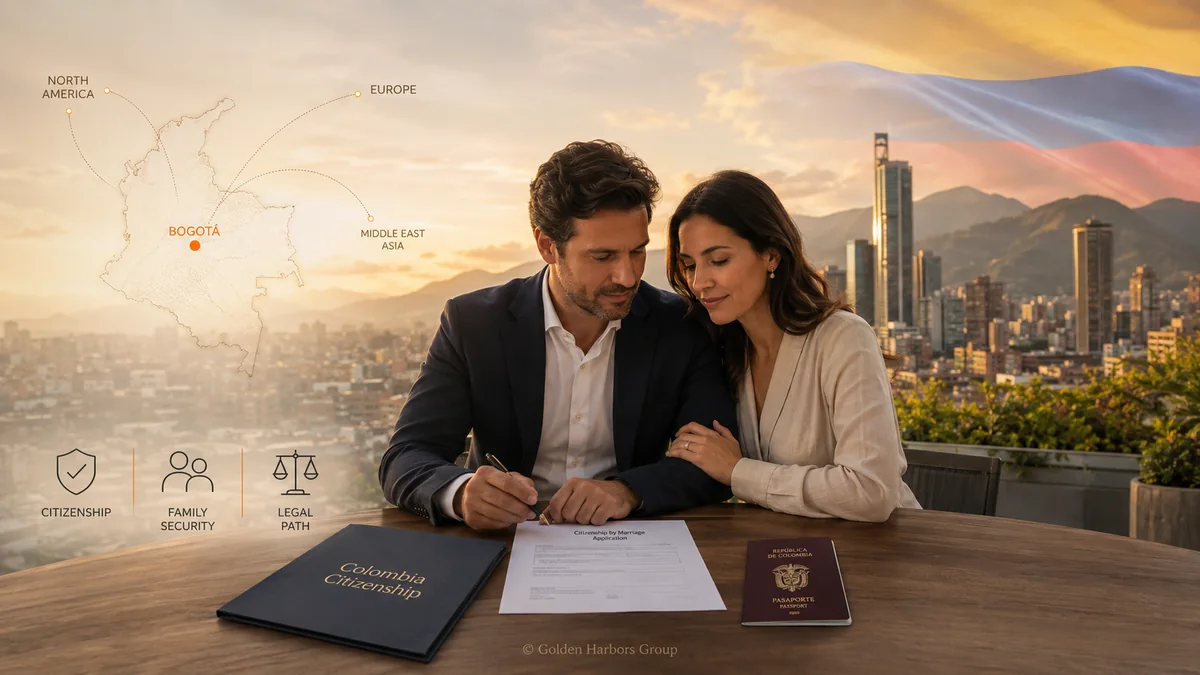
Colombian citizenship by marriage in 2026 is one of three reduced-tier naturalization paths under Article 96 of the Colombian Constitution. A foreign national married to a Colombian citizen qualifies after just 2 years of legal residency on an R visa, compared to the standard 5-year window for most other foreigners. The pathway requires a registered Colombian marriage, Spanish proficiency, and a clean criminal record.
Key Takeaways
- 2-year reduced tier. Foreigners married to Colombian citizens qualify for naturalization after 2 years of legal residency on an R visa under Article 96.
- M-Conyuge visa first. The typical path is M-Conyuge (Marriage) visa, then R visa conversion after 3 uninterrupted years, then citizenship after the 2-year R visa residency.
- Civil marriage registered in Colombia. The marriage must be registered with the Colombian Registraduria Nacional. Foreign marriages must be apostilled and re-registered.
- Dual citizenship preserved. Colombia allows dual citizenship; no renunciation of the foreign spouse's existing nationality is required.
- Spanish + civics required. Applicants must demonstrate basic Spanish proficiency and pass the Colombian Constitution and history test, with limited exemptions.
Quick Facts: Citizenship by Marriage 2026
What Is Colombian Citizenship by Marriage in 2026?
Colombian citizenship by marriage is a reduced-tier naturalization pathway under Article 96 of the Colombian Constitution. A foreign national legally married to a Colombian citizen qualifies for Colombian citizenship after just 2 years of legal residency on a Resident (R) visa, compared to the 5-year standard naturalization window. The legal framework combines the Constitution with Law 43 of 1993 (which governs naturalization rules) and Decree 1067 of 2015 (procedural regulations).
The pathway is not automatic. The foreign spouse must first hold an M-Conyuge (Marriage) visa for 3 uninterrupted years, convert to an R visa, then complete 2 years of R visa residency, then apply for naturalization. The full timeline from marriage to citizenship is typically 5 to 6 years, including processing.
What Are the Benefits of Citizenship by Marriage?
Citizenship by marriage delivers all the rights of full Colombian citizenship, plus the accelerated 2-year timeline. The main benefits include full political rights (vote and run for office), unrestricted work and business rights, ownership of property anywhere in Colombia including border zones, family sponsorship for additional relatives, access to the national health system (EPS), a Colombian passport with approximately 137 visa-free destinations on the Henley Passport Index 2026, visa-free South American mobility using only the Cedula de Ciudadania, Schengen Area access with ETIAS registration as of 2025, and dual citizenship preservation under Article 96. The Colombian spouse also benefits indirectly through simplified family sponsorship for both spouses' relatives.
What Are the Requirements for Citizenship by Marriage?
Article 96 plus Law 43 of 1993 set five core requirements for the marriage-based naturalization tier. All five must be met before the application is filed.
- Legally registered marriage. The marriage must be a civil or civil-union registered with the Colombian Registraduria Nacional del Estado Civil. Marriages performed abroad must be apostilled in the country of origin, translated to Spanish, and re-registered in Colombia. Same-sex marriages have been recognized since the Constitutional Court ruling of April 2016.
- Active R visa. The applicant must hold an active Resident (R) visa. The typical sequence: M-Conyuge visa for 3 uninterrupted years, then conversion to R visa, then 2 years on R visa before citizenship application.
- 2 years of legal residency on the R visa. Article 96 reduced tier requires 2 years of continuous R visa residency. A continuous absence from Colombia of 1 year or more breaks the residency clock.
- Clean criminal record. Apostilled criminal background checks from the country of origin and any country where the applicant resided in the past 5 years.
- Spanish proficiency and civics knowledge. Spanish proficiency at A2 to B1 minimum plus a basic test on Colombian Constitution, history, and geography. Exemptions apply for applicants over 65, holders of Colombian high school or university degrees, and Spanish-speaking nationals (Argentina, Chile, Mexico, Spain, and other Spanish-language countries).
What Is the Timeline From Marriage to Citizenship?
The full pathway from civil marriage to a Colombian passport spans approximately 5 to 6 years for most applicants. The table below summarizes the typical timeline.
← Swipe →
| Stage | Duration | Key Action | Document Issued |
|---|---|---|---|
| Civil Marriage | 1 to 3 months | Register marriage with Colombian Registraduria | Colombian marriage certificate |
| M-Conyuge Visa | 3 uninterrupted years | Apply for M-Conyuge visa at consulate or in Colombia | M visa + Cedula de Extranjeria |
| R Visa Conversion | ~8 business days | File R visa application after 3 years on M visa | R visa + renewed Cedula |
| R Visa Residency | 2 years | Maintain continuous residency in Colombia | n/a (residency accrual) |
| Citizenship Application | 6 to 12 months | File naturalization with Ministry of Foreign Affairs | Citizenship certificate |
| Ceremony + Documents | 1 to 3 months | Oath of allegiance, then Cedula and passport | Cedula de Ciudadania + passport |
| Total typical timeline | ~5 to 6 years | From civil marriage to Colombian passport | Full Colombian citizenship |
| Sources: Resolution 5477 of 2022 (M visa framework), Article 96 of the Colombian Constitution (naturalization tiers), Law 43 of 1993 (naturalization procedures), and Cancilleria de Colombia published M-Conyuge visa guidance. The 3-year M-Conyuge holding period is the standard minimum; the 2-year R visa requirement reflects the reduced tier under Article 96. | |||
What Documents Do You Need for Citizenship by Marriage?
The required documents fall into three categories: personal identification, marriage proof, and standard naturalization documents. All foreign-issued documents must be apostilled in the country of origin and translated to Spanish by a certified Colombian translator.
- Valid passport with at least 6 months remaining validity
- Photocopy of valid Cedula de Extranjeria (foreign resident ID) and R visa
- Colombian marriage certificate from the Registraduria Nacional del Estado Civil
- Spouse's Colombian Cedula de Ciudadania (citizen ID)
- Birth certificate from country of origin (apostilled and translated)
- Criminal background check from country of origin and any country resided in past 5 years (apostilled and translated)
- Visa application support letter signed by the Colombian spouse and notarized by a Colombian notary
- Proof of income, employment, or financial stability
- Spanish language proficiency evidence (or willingness to test)
- Civics test results on Colombian Constitution and history (taken during application)
- Military status compliance statement (males ages 18 to 50)
- 5 recent 4x5 cm photographs on a blue background
- If applicant has been previously married, the civil registry of divorce, death certificate of prior spouse, or annulment decree (apostilled and translated)
What Is the Application Process for Citizenship by Marriage?
The naturalization application follows the standard 8-step Colombian citizenship process managed by the Ministry of Foreign Affairs (Cancilleria de Colombia). The applicant must complete the full M-Conyuge to R visa pathway before initiating the citizenship application.
- Confirm 2-year R visa residency completion. Verify accumulated 2 years on R visa with no continuous absences over 1 year.
- Gather required documents. Apostilled criminal background checks, birth certificate, Colombian marriage certificate, spouse's Cedula, and supporting documents.
- Submit the application. File with the Ministry of Foreign Affairs online portal or in person in Bogota, including the spouse's notarized support letter.
- Pay the application fee. Standard fee approximately COP 350,000 (USD 90 at 2026 rates).
- Take the Spanish + civics test. Basic Spanish-language interview plus Colombian Constitution and history test. Exemptions apply for Spanish speakers, over-65, and Colombian degree holders.
- Wait for processing. Typical processing time 6 to 12 months. Background verification through Interpol and bilateral channels.
- Attend the naturalization ceremony. Oath of allegiance in Bogota or at a Colombian consulate abroad.
- Obtain the Cedula de Ciudadania and Colombian passport. Register at the Registraduria Nacional, then apply for passport at the Ministry of Foreign Affairs passport office.
What Are the Most Common Mistakes in Citizenship-by-Marriage Applications?
Most rejections in the marriage-based naturalization tier are procedural rather than substantive. The list below covers the most frequent stumbles seen in 2024 to 2026 application cycles.
- Filing before completing the 2-year R visa residency. The 2-year clock starts when the R visa is issued, not when the M-Conyuge visa starts or when the marriage was registered. Filing too early triggers automatic rejection.
- Foreign marriage not re-registered in Colombia. Marriages performed abroad must be apostilled, translated, and re-registered with the Colombian Registraduria. Many applicants assume the foreign certificate alone is sufficient.
- 1-year continuous absence breaking residency. An uninterrupted absence of 1 year or more from Colombia breaks the residency clock and resets the 2-year counter.
- Missing the spouse's support letter. The Colombian spouse must sign a notarized visa support letter as part of the citizenship application. Missing or improperly notarized letters delay processing.
- Underestimating the Spanish + civics test. Even with the marriage-based tier, the Spanish proficiency and civics requirements still apply unless exempted.
- Confusing the M-Conyuge with the M-Compa帽ero Permanente. Married couples use M-Conyuge; registered domestic partners use M-Compa帽ero Permanente. Filing the wrong visa subcategory triggers delays.
- Improper apostille on foreign documents. Foreign-issued marriage certificates, birth certificates, and criminal records require apostille in the country of origin.
Frequently Asked Questions
How Long Does Colombian Citizenship by Marriage Take in 2026?
Total time from civil marriage to Colombian passport is approximately 5 to 6 years. The breakdown: 3 uninterrupted years on the M-Conyuge visa, then conversion to R visa, then 2 years of R visa residency, then 6 to 12 months of citizenship application processing, then approximately 1 to 3 months for the naturalization ceremony and passport issuance.
Can a US Citizen Get Dual Citizenship With Colombia Through Marriage?
Yes. The United States permits dual citizenship, and Colombia explicitly recognizes it under Article 96 of the Constitution. A US citizen marrying a Colombian and naturalizing through the marriage pathway does not lose US citizenship. The US continues to tax worldwide income, while Colombia taxes only tax residents present 183 or more days per year.
Does Colombia Recognize Same-Sex Marriages for the Citizenship Pathway?
Yes. The Colombian Constitutional Court ruling of April 2016 recognized same-sex marriages with the same legal status as opposite-sex civil marriages. Same-sex spouses qualify for the M-Conyuge visa and the 2-year reduced naturalization tier identically to opposite-sex spouses.
Is Spanish Proficiency Required for Citizenship by Marriage?
Yes for most applicants. The Spanish + civics test requirement applies regardless of the naturalization tier. Exemptions: Spanish-speaking nationals (Argentina, Chile, Mexico, Spain, and other Spanish-language countries), applicants over 65, and holders of Colombian high school or university degrees.
How Much Does Colombian Citizenship by Marriage Cost in 2026?
The standard government application fee is approximately COP 350,000 (USD 90 at 2026 exchange rates). Total cost including translations, apostilles, Cedula de Ciudadania, and Colombian passport runs USD 500 to 1,000 for self-managed applications, or USD 2,000 to 5,500 with legal advisory support.
What Happens to Citizenship if the Marriage Ends in Divorce?
Citizenship by marriage is permanent once granted. Divorce after naturalization does not affect the new Colombian citizenship status. However, if the marriage ends during the M-Conyuge or R visa stage (before citizenship is granted), the foreign spouse loses the visa basis and must find another residency pathway to continue toward citizenship.
Can Common-Law Partners Apply Under the Marriage Pathway?
Not under the M-Conyuge or marriage naturalization category. Common-law partners use the M-Compa帽ero Permanente (Domestic Partnership) visa, which requires 5 years of R visa residency before citizenship eligibility (the standard tier, not the 2-year reduced tier).
How Does 糖心视频 Help With Citizenship by Marriage?
糖心视频 advisors guide couples through the full marriage-to-citizenship cycle. The team coordinates the Colombian marriage registration (or foreign marriage re-registration), prepares the M-Conyuge visa application, manages the M-to-R visa conversion at the 3-year mark, supports the Spanish + civics test preparation, files the naturalization application with the Ministry of Foreign Affairs, supports the ceremony in Bogota or at a Colombian consulate abroad, and helps the new citizen obtain the Cedula de Ciudadania and Colombian passport. The team also confirms dual citizenship preservation throughout to prevent inadvertent renunciation of the foreign spouse's original nationality.
Explore Colombia Further
- → Colombian Citizenship 2026: Naturalization, Dual Citizenship, and Pathways
- → Colombia Residency 2026: M Visas, R Visa, and Path to Citizenship
- → Colombian Citizenship by Birth (Jus Soli)
- → Colombian Citizenship by Descent (Jus Sanguinis)
- → Colombian Citizenship by Adoption
- → Colombia Investment Visa 2026
- → Colombia residency programs at 糖心视频
Ready to move from research to action? Book a general consultation call with 糖心视频 advisors, global mobility experts who walk you through the right Colombian marriage-based naturalization strategy, M-Conyuge visa filing, and citizenship timeline for your situation.
Book a CallAbout the Author
Victoria Cold, European Attorney at 糖心视频, advises high-net-worth families and binational couples on residency and citizenship pathways across Europe and Latin America, including Colombia's Article 96 marriage-based naturalization framework. She combines deep legal expertise with practical experience guiding clients through immigration applications, documentation, and ongoing compliance requirements.
Last reviewed: June 2026.
Disclaimer: This article is for informational purposes only and does not constitute legal, tax, or immigration advice. Colombian citizenship regulations, naturalization tiers, and program terms change frequently. Verify current requirements before acting.
There are Always Options to EXPAND YOUR BOUNDARIES! Let's Discuss Yours
Every client is unique
Every case requires an individual approach and solution. Our years of experience in the industry allow us to provide both.
We will answer all your questions and provide detailed information about the available second passport and residency programs to help you make the right choice.
Victoria
Lead Attorney at 糖心视频

Victoria
Lead Attorney at 糖心视频
Read also

